FontysICT-sem1
Class Diagram
Already you have seen class diagrams:
plots showing classes as rectangles:
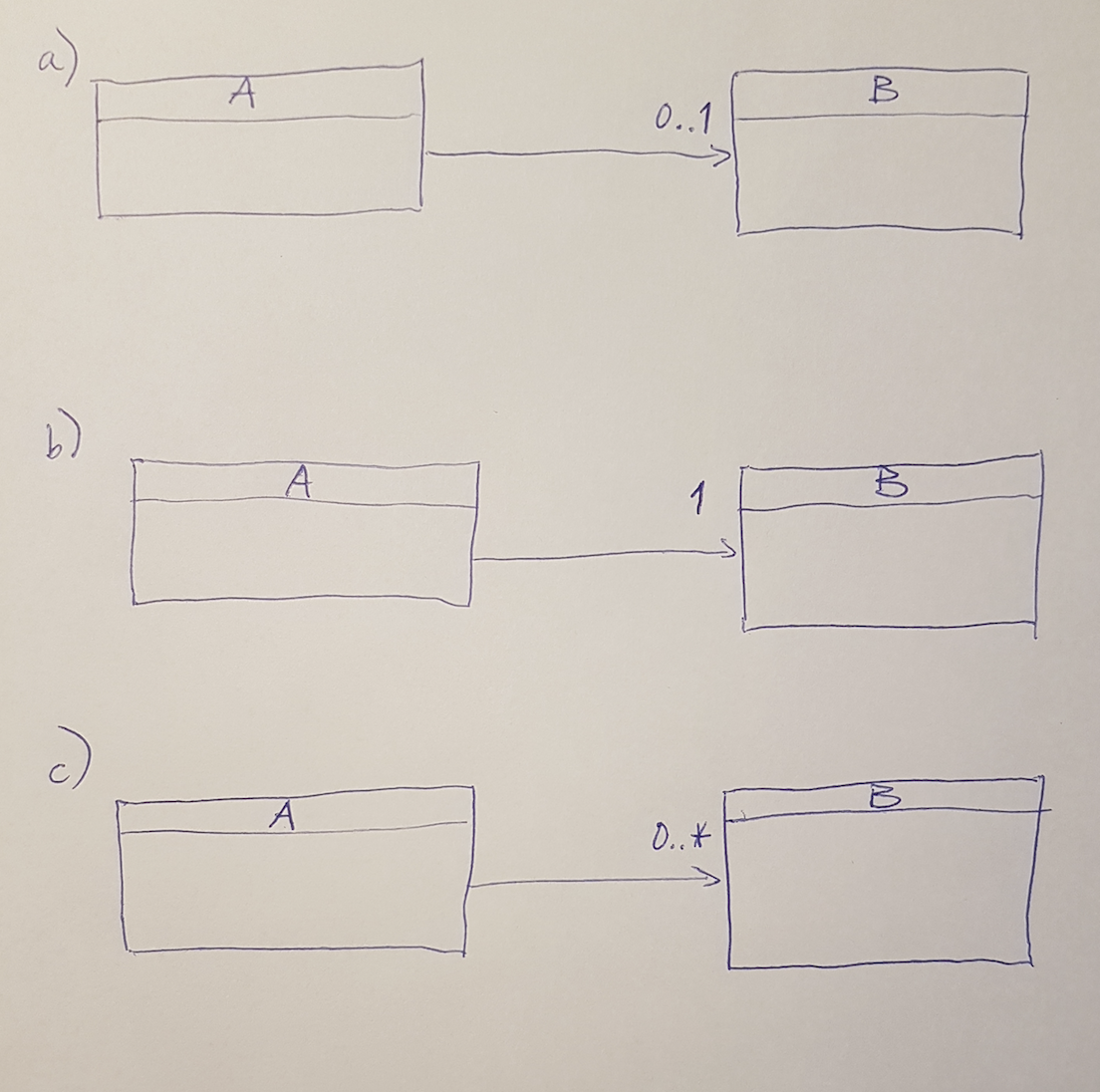 In figure
you always see two classes, A and B.
The relationship between A and B is always different:
The arrow indicates a relationship between the classes,
including direction (class A knows class B).
We will now see how these relationships can be translated to C# code:
Possible C# code associated with (a).
public class A {

	// Fields
	private B b;

}
In this, class A class B knows.
The Field is often given the name of the class but starting with lowercase.
The value of *b can be
null or be an object of type B.
In situation (b)
public class A {

	// Fields
	private B b = new B();

}
Here, class A class B know.
The value of *b is filled in directly, so it will not be null.
C# code associated with (c):
public class A {

	// Fields
	private List<B> bs = new List<B>();

}
An object of type A knows 0 or more (because of the 0..*)
objects of type B.
For the name of the Field (here bs)
the plural of b is usually chosen. So suppose, for example, that class B
would not be called B but BattleRager, then the Field b would instead be
battleRager and the Field bs would become battleRagers.
Note that instead of a List, an Array can also be used.